AI agent, in one sentence
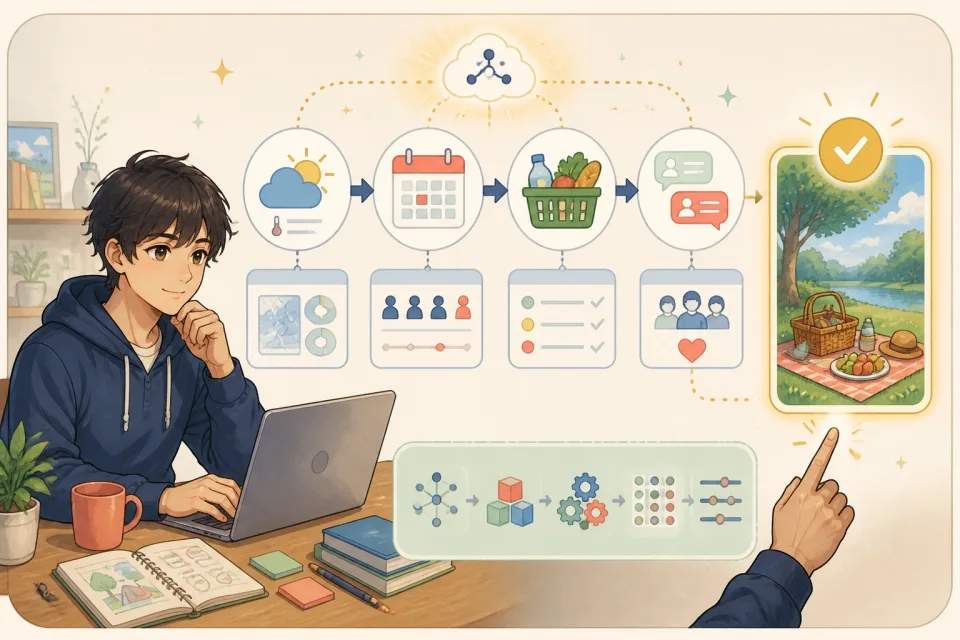
An AI agent is a system that can work through multiple steps toward a goal, often by choosing actions, using tools, observing results, and adjusting what it does next.
The word “agent” covers many designs. Some agents follow a short, tightly controlled workflow. Others can make more choices about which tool to use or which step to attempt next. Being called an agent does not mean a system is conscious or independent of human rules.
What are the core parts of an AI agent?
A goal
The goal describes the result the agent should work toward. A useful goal is specific enough to guide decisions and includes important boundaries.
A plan or next-step process
The agent may create a plan in advance or decide one step at a time. It can revise the plan when a tool fails or new information changes the situation.
Tools and permissions
Tools let an agent do more than generate text. Examples include searching approved sources, reading a file, querying a database, calculating a value, or updating a permitted system. Permissions determine what the agent is allowed to access or change.
State or memory
The system needs enough state to know what it has already tried, what it learned, and what remains. This may be temporary context for one task or longer-lived information governed by explicit rules.
Feedback
After an action, the agent observes the outcome. That feedback helps it decide whether to continue, retry, choose another tool, request help, or stop.
Simple loop: understand the goal → choose a step → use a permitted tool → inspect the result → decide what comes next.
AI agent vs chatbot
| Basic chatbot | AI agent |
|---|---|
| Mainly responds to the current message. | Works through multiple steps toward a goal. |
| Often ends after producing an answer. | Can inspect results and decide on another action. |
| May answer from its model and current context. | May use permitted tools, files, APIs, or external systems. |
| The user directs most transitions. | The system may choose some transitions within defined boundaries. |
The boundary is not absolute. A conversational assistant may also use tools and carry out multi-step tasks. “Agent” is most useful when it highlights the system's ability to act, observe, and continue.
A simple AI agent example
Imagine a travel-planning agent asked to propose a weekend itinerary within a budget:
- It identifies missing constraints such as dates, starting point, and accessibility needs.
- It uses approved travel tools to find current transport and accommodation options.
- It checks the combined cost against the budget.
- It revises the plan when an option is unavailable or too expensive.
- It presents a proposed itinerary with sources and asks the user to approve any booking.
The agent is useful because it coordinates several steps. The approval boundary is equally important: proposing an itinerary is lower risk than spending money or accepting cancellation terms.
How should people supervise AI agents?
- Limit access. Give the agent only the tools and data needed for the task.
- Require approval. Pause before purchases, messages, deletions, account changes, or other consequential actions.
- Make actions visible. Keep useful records of what the agent tried and why a step failed.
- Test failure cases. Check what happens when information is missing, a tool returns an error, or instructions conflict.
- Provide a stop mechanism. People need a reliable way to interrupt, correct, or roll back the process when possible.
Oversight should be proportional to risk. A draft organizer can have more freedom than an agent that touches money, health information, production systems, or communication with other people.
How AI From Zero teaches AI agents
The dedicated AI Agents course has six sections: Meet AI Agents, Plans and Loops, Tools and Permissions, Memory and Teamwork, Control and Safety, and Using Agents Wisely. Each section connects a capability with the boundary that keeps it useful.
That means permissions are taught alongside tools, clear handoffs alongside multi-agent work, and approval gates alongside actions with impact. The course also covers reversibility and the risk of outside content giving an agent hostile instructions. See the full AI From Zero curriculum.
Frequently asked questions
What is an AI agent in simple terms?
An AI agent is a system that can work through multiple steps toward a goal, often by choosing actions, using tools, observing results, and adjusting what it does next.
How is an AI agent different from a chatbot?
A basic chatbot mainly produces a response to each message. An AI agent can continue beyond one response by planning steps, using permitted tools, checking results, and taking further actions toward a goal.
Do AI agents need human oversight?
Yes. The amount of oversight should increase with the possible harm of an error. People should define permissions, require approval for sensitive actions, monitor behavior, and keep a way to stop or correct the system.
AI From Zero includes a visual AI Agents course covering goals, plans, tools, memory, oversight, and safety. View AI From Zero on the App Store.